

Howdy! So check this out..
Imagine the SAT gives you a problem that asks you to add a giant pile of numbers like this:
What do you do?
Do you actually sit there and add every single number one at a time?
You could… but the SAT is secretly hoping you know a faster way.
In fact, there are special formulas that let you add long lists of numbers super quickly. Once you learn them, you’ll feel like you discovered a cheat code for SAT Math.
And if test anxiety or SAT anxiety ever makes long-looking problems feel stressful, these shortcuts can help calm your brain down because suddenly the problem becomes simple and organized.
Let’s break these formulas down in the easiest way possible.

1. Sum of Consecutive Integers
This formula helps you add numbers that increase by 1 each time.
Examples:
- 1 + 2 + 3 + 4 + 5
- 12 + 13 + 14 + 15
The formula is:
Where:
- = number of terms
- = first number
- = last number

Practice Problem
Find:
Step 1: Count the terms
There are 5 numbers.
So:
Step 2: Identify the first and last number
First number:
Last number:
Step 3: Plug into the formula
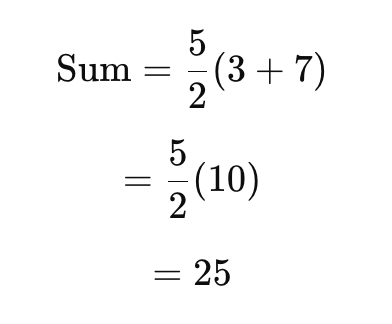
So:
Way faster than adding them one at a time like a calculator from 1987.

2. Sum of Consecutive Odd Integers
This formula works when you’re adding odd numbers in a row.
Examples:
- 1 + 3 + 5 + 7
- 11 + 13 + 15
The formula is:
Where:
- = number of terms
- = first odd number
- = last odd number
Practice Problem
Find:
Step 1: Count the terms
There are 4 terms.
Step 2: Identify the first and last number
First number:
Last number:
Step 3: Plug into the formula
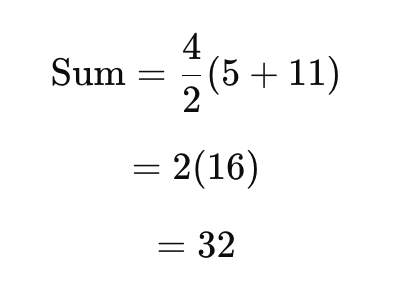
So:

3. Sum of Natural Numbers
This formula is specifically for adding numbers starting at 1.
Examples:
- 1 + 2 + 3 + 4 + 5
- 1 + 2 + 3 + … + 100
The formula is:
Where:
- = the last number
Practice Problem
Find:
Step 1: Identify the last number
Step 2: Plug into the formula
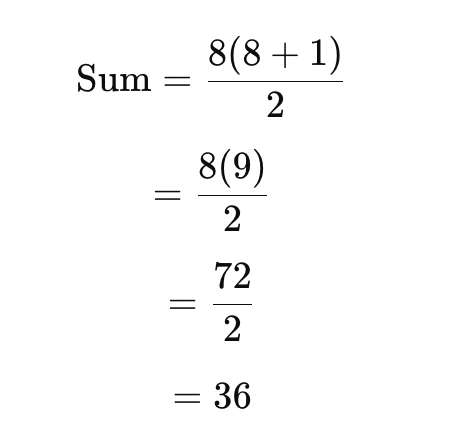
So:
Why These Formulas Matter on the SAT
The SAT loves problems that:
- Look long
- Look annoying
- Look like they’ll take forever
But usually there’s a shortcut hiding inside.
These formulas help you:
- Save time
- Avoid silly mistakes
- Stay calm under pressure
And honestly, that’s huge when SAT anxiety starts creeping in.

Quick Trick for Remembering the Main Idea
These formulas are basically doing this:
Average × Number of Terms
That’s really the secret.
Instead of adding every number one at a time, the formula finds the average value and multiplies it by how many numbers there are.
Pretty clever.

Final Thoughts
A lot of SAT math isn’t about doing hard calculations. It’s about spotting patterns and knowing the shortcut.
Once you get comfortable with these formulas, giant scary-looking addition problems suddenly become quick points.
And quick points are your best friend on test day.
Keep practicing, keep things simple, and keep checking back here for more SAT math shortcuts and strategies.
You’ve got this!